Recently I stumbled upon regulations by the Egyptian Chamber of Diving and Water Sports. It is nice to know that some nations know how important it is to protect their reefs and know how to enforce that. These regulations also seem to try to improve diving operations safety. At the moment I'm not sure how many diving injuries where reported in Egypt and how many of them happened during deep recreational dives, but requiring operators to limit maximum depth to 30 meters seems to be reasonable, especially with all East European divers going to Egypt. I wrote that because, unfortunately, these divers are know to notoriously exceed depth limits set by their certifications. Of course other nationalities also do that, but not as often.
What I like the most about aforementioned regulations, is the ban on Discover Scuba Diving dives on the most spectacular reefs in the Sharm el Sheikh region, including Ras Mohammad and Tiran Strait. As for other dive courses - the possible dive sites have also been limited. Any instructor or divemaster knows what a diver who is still developing his buoyancy control can do to a reef...
Saturday, 30 May 2009


Saturday, 25 April 2009
Diving the wrecks of Coron Bay
For the last three days we've been diving the wrecks of Coron. Located just to the north of Palawan, on the island of Busuanga it is one of the most spectacular wreck diving sites. Amongst the scenic bays and narrow passages between islets surrounding Busuanga lie Japanese navy's auxiliary transport vessels. They were sunk during two air strikes on September 24th and October 9th 1944.
Altogether there are 7 wrecks around Busuanga, but we dove only 6 of them:
All the diving was done from the spiderlike bancas, traditional filipino boats now used for everything from transport to fishing to diving. The wrecks are rather deep for recreatioal diving, ranging from 25 to 45 meters, and all the dives we did were penetration dives. It is very easy to exceed your No Decompression Limits under such circumstances, especially if the divemaster minds only his computer which is less conservative than yours. After spending 17 minutes on decompression stop on the first days second dive we decided to use nitrox for second dives on the last two days.
The wrecks were just amazing, especially the auxiliary oiler Okikawa Maru. With her spacious tanks. Although the visibility outside was just 10 meters, inside the wrecks the water was much clearer (until someone made a false move and stirred up the silt...).
All of the dives were penetretion dives, though for less experienced divers it is also possible to stay outside the wrecks and still have a lovely dive. We were ofcourse led by a divemaster, otherwise we would have probably gotten lost and I wouldn't be writnig this. Inside the wrecks are rather comfortable, though we had to watch our heads most of the time and there were a few tight squeezes - we once exited a wreck through a propeller shaft.
Altogether there are 7 wrecks around Busuanga, but we dove only 6 of them:
- Okikawa Maru
- Akitsushima
- Taiei Maru
- Olympia Maru
- Tangat Wreck
- Irako
All the diving was done from the spiderlike bancas, traditional filipino boats now used for everything from transport to fishing to diving. The wrecks are rather deep for recreatioal diving, ranging from 25 to 45 meters, and all the dives we did were penetration dives. It is very easy to exceed your No Decompression Limits under such circumstances, especially if the divemaster minds only his computer which is less conservative than yours. After spending 17 minutes on decompression stop on the first days second dive we decided to use nitrox for second dives on the last two days.
The wrecks were just amazing, especially the auxiliary oiler Okikawa Maru. With her spacious tanks. Although the visibility outside was just 10 meters, inside the wrecks the water was much clearer (until someone made a false move and stirred up the silt...).
All of the dives were penetretion dives, though for less experienced divers it is also possible to stay outside the wrecks and still have a lovely dive. We were ofcourse led by a divemaster, otherwise we would have probably gotten lost and I wouldn't be writnig this. Inside the wrecks are rather comfortable, though we had to watch our heads most of the time and there were a few tight squeezes - we once exited a wreck through a propeller shaft.
Tuesday, 21 April 2009
Diving the Malapascua Island
20+ dive sites around the island, most of them only 10 minutes away. I haven't seen any sharks, but thats probably just my luck. I have, however, seen lots of small stuff: nudibranchs, different shrimp, crabs, pipefish, sea moths and some other weird things that I'm not able to name..
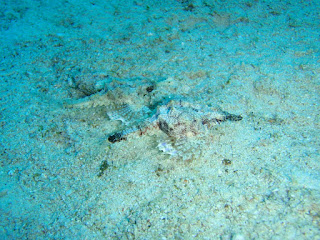

The sad thing about this island is that during diving you can hear underwater blasts all the time. Yes, people are fishing with dynamite around here, and lots of corals are broken:/

Sea moths

The sad thing about this island is that during diving you can hear underwater blasts all the time. Yes, people are fishing with dynamite around here, and lots of corals are broken:/
Tuesday, 7 April 2009
Bye bye Samui
Tomorrow we are leaving Koh Samui, setting off on a 4 month travel through South East Asia. We are going to visit the Philippines (do some diving there :D), Vietnam, Cambodia, Laos, then pass through Thailand en route to Malaysia and finally Singapore.
And although I enjoyed living on Samui pretty much, I am very excited to be moving somewhere new.
And although I enjoyed living on Samui pretty much, I am very excited to be moving somewhere new.
Sunday, 15 March 2009
Galvanic corrosion of regulators
Knowing that South East Asia uses almost exclusively A-clamp (INT connector) we purchased two Scubapro's aluminium DIN to INT adapters (yeah, wanted to save some weight on air travel) for our Apex DS4/ATX-40 regulators.We knew that, as the 1st stage is made of admiralty brass and the adapter of aluminium, there might be some problems with galvanic corrosion between these two parts. And there were... Basically galvanic corrosion is an electrochemical process when in which one metal (e.g.. aluminium) corrodes preferentially when in contact with different metal (e.g. brass) and both metals are immersed in electrolyte (e.g.. salt water). This means that a metal that normally wouldn't corrode will when contacted with another one. But what does that mean for a mere mortal? Well, same as with a rusted screw that you cannot to unscrew, two metals can "rust" together. And this is what happened to Magda's reg and her yoke adapter. We tried everything, short of angle grinder and ultrasound bath, but the parts just won't budge:/
Fortunately the preventive measures I undertook (unscrewing the adapter from time to time and greasing the threading with silicon grease) turned out to be sufficient:D
Fortunately the preventive measures I undertook (unscrewing the adapter from time to time and greasing the threading with silicon grease) turned out to be sufficient:D
Friday, 6 February 2009
Whale Shark
Today I've seen my first whale shark:):):) It happened on Sail Rock, one of the best dive sites in the Samui area.
Whale sharks really are the "gentle giants", even though the one today was "only" 5 meters long. Generally whale sharks can grow up to 18 meters according to some sources.

Whale sharks really are the "gentle giants", even though the one today was "only" 5 meters long. Generally whale sharks can grow up to 18 meters according to some sources.

Saturday, 6 December 2008
Bangkok protests
Bad, bad times for diving industry in Thailand. The opposing party supporters ("yellow shirts") have blocked Thailand's largest airport - the Suvarnabhumi International Airport in Bangkok (read more) . This basically means that people have extremely hard time leaving Thailand, with plenty oftourists stuck on this airport. Those who are coming can choose alternative routes (e.g. through Kuala Lumpur), but still it has been made harder for them. This situation will also make lots of people reconsider their travel plans:/
Effects can be seen on Samui - empty streets, restaurants and hotels, not much movement in the diving industry. On top of that we have the economic crisis (lots of talk about that, but I'm still not sure if it affects tourism that much) and bad weather.
We were to begin our trainig with Easy Divers, but because of all this the boat was canceled all past week, so we cannot start this training (which is basically getting to know the dive sites), not to mention working:/.
Today was the King's birthday and everyone expected him to say something about these protests during his speech which he always gives on his birthday, but because of some illnes the event was cancelled.
Hopefully not all of those who booked their hotels for the Christmas period (a little high season here on Samui) will not cancel.
Subscribe to:
Posts (Atom)