Showing posts with label PADI Specialties. Show all posts
Showing posts with label PADI Specialties. Show all posts
Saturday, 10 April 2010
Dry suits
Finally did a dry suit course:) We did all three dives in a lake near Warsaw with visibility ranging from 30 to 50 centimetres, and I was diving in an XL suit that was leaking, but we did it:) And another card coming to my deck


Wednesday, 7 May 2008
Diving Hvar, Croatia
A day after the "basic skills demonstration" exam we were on our way to Croatia for 7 days of diving. We hoped to do at least a part of our Divemaster practical training as this diving trip was organized by our diving center, Nautica Warszawa, and there were about 50 people. The practical training is a part of the divemaster training, it is a kind of internship - you participate, under your instructors supervision, in different courses: OWD, AOWD, Rescue one chosen speciality and you must also practice leading certified divers. This is one of the possible ways of passing the practical part of the divemaster course. The other one is so called Practical Training Excercises which basically is just simulation of the aforementioned courses. I think that the internship is a better way of learning because you deal with real divers and their problems and take part in real courses. This way you gather more experience.
It is important for us to get the Practical Training done as soon as possible because this is the most unpredictable part of the course. Our friend that was doing the previous divemaster course got stuck because nobody wanted to do the AOWD course in winter in Poland...
Unfortunately it turned out that nobody wanted to do any courses, they just wanted to dive... As there were no courses we did some diving ourselves.
Nautica Croatia is located in Stari Grad on the island of Hvar in Croataia.
View Larger Map
Sealife in waters around Hvar is not as rich as in Egypt (the water is much colder, around 15 degrees Celsius), but still you can find some interesting fish, like the angler fish below
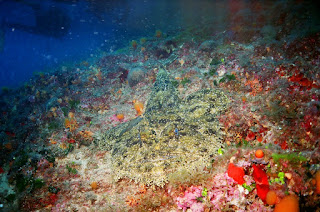
Apart from that you can find lots of nudibranchs, urchins and other fish typical of the Mediterranean.
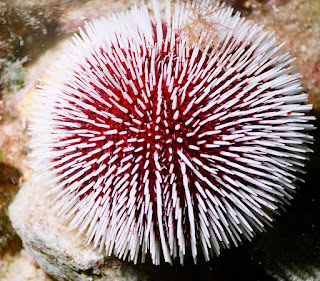
Almost all of our dives were boat dives, we did however 4 dives from the shore during the Map Making assignment of the DM course (we had to do something to push things forward!).

Additionaly we did the PADI Deep Diver course, so I'm expecting a new card to my C-Card collection :)
It is important for us to get the Practical Training done as soon as possible because this is the most unpredictable part of the course. Our friend that was doing the previous divemaster course got stuck because nobody wanted to do the AOWD course in winter in Poland...
Unfortunately it turned out that nobody wanted to do any courses, they just wanted to dive... As there were no courses we did some diving ourselves.
Nautica Croatia is located in Stari Grad on the island of Hvar in Croataia.
View Larger Map
Sealife in waters around Hvar is not as rich as in Egypt (the water is much colder, around 15 degrees Celsius), but still you can find some interesting fish, like the angler fish below

Apart from that you can find lots of nudibranchs, urchins and other fish typical of the Mediterranean.

Almost all of our dives were boat dives, we did however 4 dives from the shore during the Map Making assignment of the DM course (we had to do something to push things forward!).

Additionaly we did the PADI Deep Diver course, so I'm expecting a new card to my C-Card collection :)
Sunday, 9 December 2007
On Nitrox
So, now that I've become a nitrox diver I can reveal some secret nitrox knowledge:). Below goes an executive summary of nitrox diving. You can find a more detailed description on Wiki (wiki EAN).
Nitrox is a mix of nitrogen and oxygen. Usually nitrox contains more oxygen than air (>21%) and in such case it's called Enriched Air Nitrox or EAN. Some call any mixture of these two gases nitrox. For recreational diving a blend of up to 40% of oxygen is used, however technical divers use hotter (containig >40% oxygen) nitroxes to accelerate decompression. The two most popular mixes are EANx32 and EANx36 containing respectively 32% and 36% of oxygen.
Nitrox diving has become popular because because of the advantages this breathing mix offers. The main advantage is that because of lower nitrogen level divers body absorbs less nitrogen and thus the No Decompression Limits (NDLs) are longer. That means one can spend more time underwater or increase the seafty margin by using nitrox and staying withing air NDLs. Some people also report feeling less tired after a nitrox dive compared to an air dive. Previously people thought that breathing nitrox reduces effects of nitrogen narosis, however this turned out to be untrue because oxygen's narcotic potential is even higher:)
There are some dangers when it comes to diving with EAN and these are: oxygen toxicity and risk of fire/explosion. Both of these come from the increased level of oxygen in the mix and are easily avoided.
Fire may be caused when oxygen rich breathing mix comes into contact with materials that are not oxygen compatible or not oxygen clean, meaning that they simply start to burn in contact with such mix. To avoid this simply use oxygen clean and compatible equipment when diving with nitrox.
There are two types of oxygen toxicity: central nervous system oxygen toxicity (CNS) and pulmonary oxygen toxicity. The cause of CNS is still unknown, it is observed when the partial pressure of oxygen in the breathing mix is above 1.4 ata. CNS may result in convulsions (the most severe case), which may be lethal to a diver. Pulmonary oxygen toxicity is caused by prolonged exposure to higher than normal oxygen levels and results in lung inflamantion, coughing and decreased lung volume. These symptoms usually recede. To avoid oxygen toxicity you must monitor your oxygen exposure and maximum operating depth (MOD). MOD is the depth at which oxygen partial pressure reaches the maximum safe level (1.4 ata). Modern diving computers can usually track both of these parameters and alert the diver when he is reaching the limits. This feature does not mean you don't have to plan your dive.
Diving cylinders used with nitrox should be specially marked and have the MOD for the mix that they contain written on them. To mark cylinders usually a sticker is used, just like the one below:

EAN can be obtained by different methods. Generally you can add some oxygen to air or remove some nitrogen from it. Adding oxygen is done in partial pressure mixing or continuous blending mixing and oxygen removal is performed by using a special membrane in gas separation mixing
Wikipedia has a fairly good article on gas blending
Thursday, 6 December 2007
EAN Done :)
Passed the exam, which was fairly easy. In fact all the PADI certification exams I passed so far were not too hard. I mean, of course the theoretical part, because the Rescue Diver diving part was a killer. Especially the 'climb the ladder with your buddy sitting on your knee' part. We almost failed that...
Anyways, we are now certified EAN divers, which isn't a big progress towards becoming a DM, but during the course we got to talk to some divemasters at our center. That gave us some insight into prospects of divemastering here, in Poland, and they weren't very bright, though they weren't very pessimistic either.
And apart from all of the above the first step towards tec diving has also been made:D
Tuesday, 4 December 2007

Monday, 3 December 2007
PADI loves you...
...PADI wil organize some training for you. Why? Because PADI loves when you take new courses. Even if they're the tiny little ones, like the Enriched Air Diving or Equipment Specialist specialties. Each time you sign up, you pay PADI for the book (you have to buy it) and the C-Card (if you don't buy it then what's the point in doing the speciality?). Ofcourse you also pay for the training, but that's OK - instructors have to earn their living. For simple specialties the cost of the certificate and the book can be equal to the cost of the training:/ That's why PADI likes when you develop your skills.
And after the course you end up with a deck of C-Cards you should carry with you when you go diving...
This problem is less annoying when it comes to more complex courses, like Rescue Diver or Divemaster. The cost of handbook and C-Card is not so big compared to the overall cost of this courses, and they take you to a next level of your diving career (and you can discard your previous ccards :) ).
Oh, and there are also the "Crewpacks" - you can get, for example, an original Rescue Diver badge:>
I'm not against C-Cards, but when you have several specialties they get troublesome. And sometimes you just HAVE TO learn new ways to dive. Ie.: Dry Suits (water is cold in Poland, for me two longer dives a day is much), Deep Diver (some things ARE deep down, and I'm thinking about Tec Deep Diver), Ice Diver (to dive in winter), Wreck Diver, etc.
For each of these specialties I will get a card, so it`ll be about 10 cards to carry... It would be nice if I just had one card for all specialties and get a hologram sticker from my instructor each time I pass a new exam. The diving center would report my specialties to PADI HQ (like they do now) so there would be record of my training. PADI people, think about that....
Saturday, 1 December 2007
Rich Air
Funny little specialty. No dives necessary, just theory, about 6 hours. The Enriched Air Diving coursebook has only 100 pages, most of which are pictures (as usual). So today we've learned about Equivalent Air Depth, CNS, POT and some other things. Got some new tables, though they are almost the same as standard RDP. Next class is going to be more fun as we are going to use oxygen analyzers and, of course, write the exam.
Subscribe to:
Posts (Atom)